
kindles are chic
be so for real about your reading
Recently, I’ve been reading Zadie Smith’s book of essays, Dead and Alive. And what do you know? Smith, on more than one occasion, mentions reading on a Kindle.
Gasp! An author who was shortlisted for the Booker prize reads on one of those little tablet things? “Surely it can’t be,” those who don’t read voraciously say. And yet it is, printed (ironically) in every copy of her most recent book.
As someone who has herself taken up reading on a Kindle, I believe I know exactly how it came to be that Zadie Smith owns one. It gets to the point at which one’s book collection is extensive—coming out of your ears, even. There is only so much room I, a person who lives with her mother, have available to me: the top of my dresser, the space my mum begrudgingly bequeathed to me in the living room. And even if I did have a room dedicated to all the books I owned (like I imagine Zadie Smith does), it would still, eventually, reach capacity.
Enter: the Kindle (or Kobo or other e-readers). Smaller than the size of a Penguin Classic, it stores every possible book one could own. It is an inevitability in the lives of people who read a lot. Too many times has the book in my bag been squirted with hand sanitiser, had the pages squashed by my phone, or the cover ripped when I absentmindedly shove something away. The Kindle, however, will fit in the back pocket of your jeans (à la Jacob Elordi but make it digital), and be so discrete you forget you’re even carrying it.
I understand the Kindle may impede on your Kaia Gerber aesthetic. The performativity of whipping out a physical book, and not an electric device, is a rush (let alone using it as a paparazzi shield as Ms Gerber does). I vividly remember a time when I sat outside a classroom, waiting for my tutorial to begin, when I pulled out the book I purposefully packed to read, hoping the guy I liked would see me and have an easy way to start a conversation. Admittedly, Kindles have less of this allure.
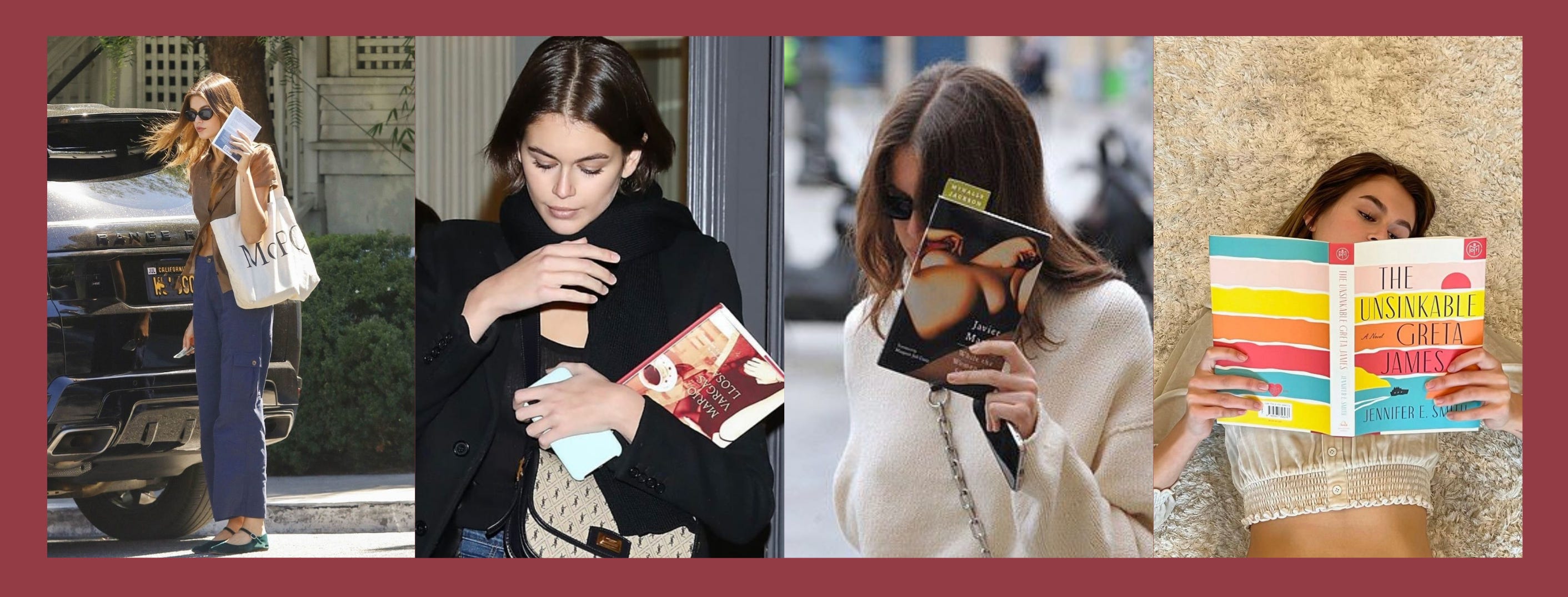
I, too, was skeptical of the Kindle. How is it any different to reading on a phone? Will everyone assume I’m reading smutty romance books?1 I like being able to crack a spine and scribble in a margin. But, I knew if I was serious about my reading, and the impact it was having on my bank account, I’d need to move to a Kindle sooner or later. So, I bought one, telling myself it means books will be cheaper, and I won’t have to lug around hardcovers.
The first book I read on my newly acquired eReader was Good Material by Dolly Alderton. Did I love it? No. Did I read it in record time, swiping to the next page every minute or so, able to easily digest and enjoy a novel? YES.
I was so immediately proved wrong in any preconceived ideas I had of the Kindle. It has made reading so much more enjoyable for myself, less laborious, more easily done in, as Stephen King says, small sips.
In mentioning the King, I draw your attention to Figure 1. In between innings, King whipped out his iPad to read—in 64pt text, mind you—a book.
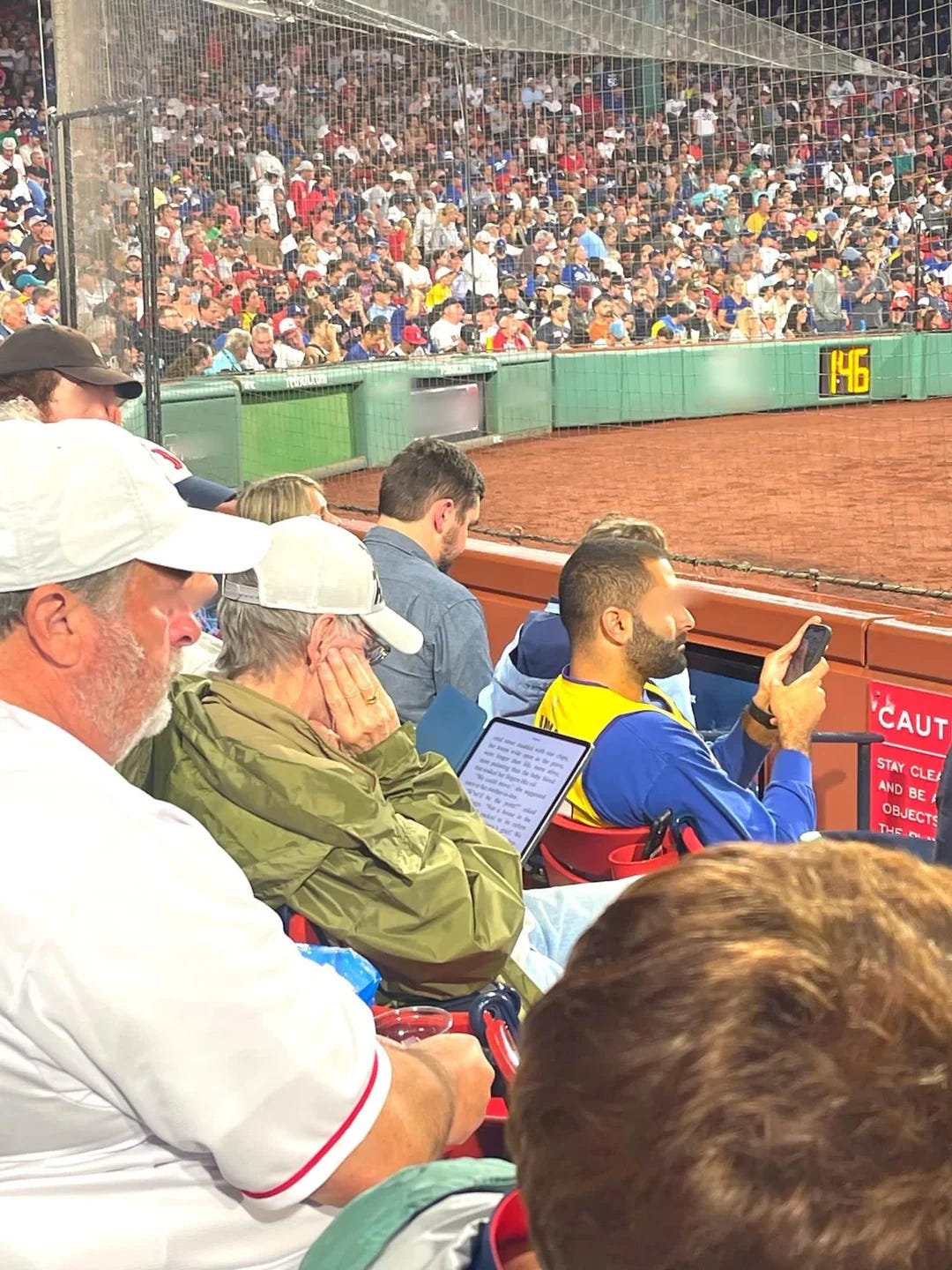
King is a self-proclaimed voracious reader, advocating for audiobooks be devoured during times when one’s hands aren’t free to hold some other reading vessel. Reading to him does not discriminate depending on form—it will always be more important that someone is reading.
Like wired headphones and film cameras, Kindles will evolve—should evolve—into an iykyk device. Big readers and award-winning writers alike know that to really put in a shift, to read as much as you intend to, Kindles (or eReaders of any kind) are an inevitability. And if it takes eReaders being made chic for you hardcover fanatics to consider them, I assure you there is nothing more chic than someone who, at any given moment, can start reading, and so with one hand.
I would be. It is always statistically likely I’m reading a smutty romance book.
This! I love my Kindle in a very unglamorous, everyday way, the way you love something that’s always there for you. It has definitely made reading feel more intimate and deeply mine.